
Choosing the best Lumbar Traction Table requires more than comparing prices, motors, and promotional claims. A table may look impressive in a showroom yet feel awkward during real clinical use. The better question is practical: Can it deliver controlled traction, support different patient sizes, and fit your treatment workflow?
Dr. James M. Cox, a recognized authority in non-surgical spinal care, has stated, “The goal of Cox Technic is to reduce pain and increase function.” His principle matters when evaluating equipment. A quality Lumbar Traction Table should support careful clinical judgment, not replace it. Look for adjustable pelvic and thoracic sections, smooth mechanical movement, dependable locking systems, and clear force controls. The padding should remain stable beneath the patient, even during repeated sessions. Small details matter.
Safety comes first.
A trustworthy buyer should examine manufacturer documentation, warranty coverage, service access, electrical certifications, and user training. Tables with excessive features may create unnecessary complexity. Basic models may limit treatment options later. That trade-off deserves honest consideration. Patient comfort also affects cooperation; cold vinyl, noisy motors, or difficult restraints can undermine an otherwise sound treatment plan.
This guide compares important table types, clinical features, construction quality, and ownership costs. It also considers what specifications mean in daily practice. No single model suits every clinic. The best choice depends on treatment goals, patient population, available space, and professional experience. Even experienced clinicians can overlook maintenance time or staff ergonomics. That is where careful evaluation becomes more valuable than persuasive advertising.
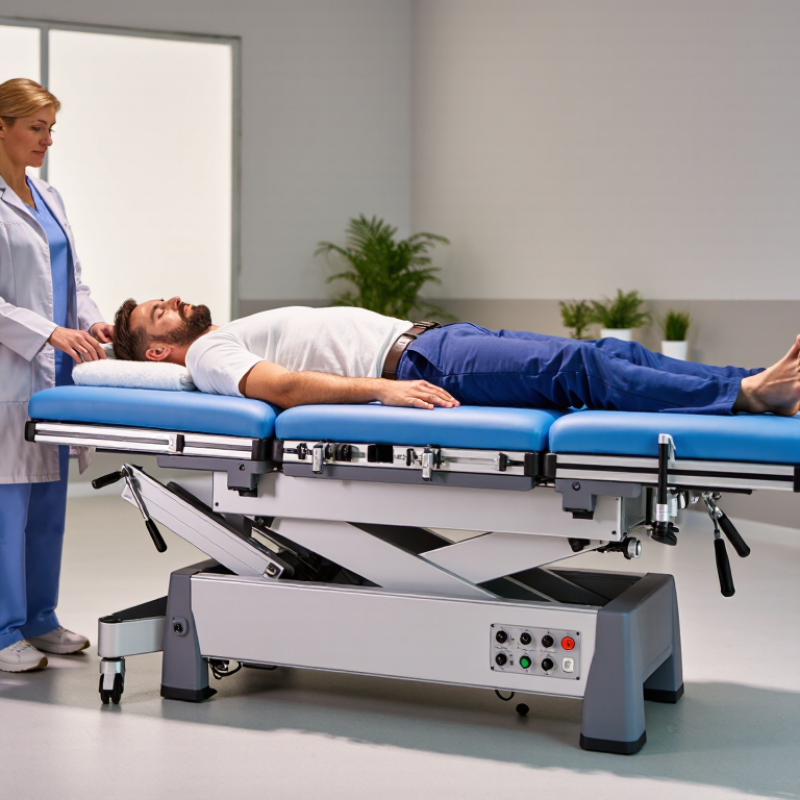
A lumbar traction table uses a padded surface, pelvic harness, and controlled pulling force. The table gently separates the lower spinal segments. Some models also flex the table during treatment. This may temporarily reduce pressure, ease muscle guarding, and create space around irritated nerve roots. It does not permanently “put a disc back.”
The World Health Organization reports that low back pain affected about 619 million people worldwide in 2020. That figure may reach 843 million by 2050. However, traction evidence remains mixed. A Cochrane review found little meaningful benefit for many people with chronic low back pain. The 2021 JOSPT clinical practice guideline recommends traction only cautiously for selected patients, especially when leg symptoms and certain movement patterns are present. The evidence is not perfectly tidy. A costly table is not automatically the best table.
Tips: Choose a table with adjustable force, secure pelvic support, emergency release, and clear load limits. Ask a licensed clinician to assess your symptoms before treatment. Avoid self-testing high force. Stop if numbness, weakness, sharp pain, or worsening leg symptoms appear. A practical trial should record pain, walking tolerance, and sleep before and after several sessions. If nothing improves, reconsider the plan. Some people respond well; others notice almost nothing. That uncertainty deserves honest discussion.
When choosing a lumbar traction table, patient selection matters more than maximum pulling force. The World Health Organization reported that low back pain affected 619 million people globally in 2020. However, most patients do not need traction. They may benefit when leg pain suggests nerve-root irritation, especially with limited spinal movement or symptoms that ease during unloading.
A physical therapist should screen for fracture, infection, cancer, severe osteoporosis, progressive weakness, and cauda equina symptoms. These warning signs require medical assessment, not routine traction. Patients with nonspecific mechanical back pain may experience short-term comfort, but evidence for lasting improvement remains limited. The Cochrane review on traction for low back pain found little meaningful benefit compared with other treatments. NICE guideline NG59 also advises against traction for routine low back pain or sciatica.
For a clinic, I would prioritize adjustable force, accurate angle control, pelvic and chest restraints, and an immediate release system. The table should support careful monitoring, not replace clinical judgment. Treatment may be reasonable for a carefully selected patient with radiating pain and confirmed mechanical sensitivity. Yet the evidence is not perfectly consistent. That matters. A 2021 Journal of Orthopaedic & Sports Physical Therapy guideline recommends against routine mechanical traction for chronic low back pain with leg pain, while acknowledging that certain clinical subgroups may respond. Patients should track leg pain, numbness, walking tolerance, and function after each session. Pain relief alone can mislead. The best table is the one used by a qualified clinician with reassessment built into every visit.
| Table Configuration | Typical Features | Patients Who May Benefit | Important Limitations or Precautions | Key Buying Criteria |
|---|---|---|---|---|
| Manual lumbar traction table | Uses therapist-controlled positioning and manual force; generally has fewer mechanical controls and a lower purchase cost. | Patients needing short, closely supervised sessions or conservative trial treatment before considering motorized equipment. | Force and treatment consistency depend heavily on clinician technique. It may be less suitable for repeated, precisely measured traction protocols. | Stable frame, adjustable height, secure pelvic support, comfortable padding, and easy therapist access. |
| Motorized intermittent traction table | Provides programmable cycles of traction and relaxation, with adjustable duration, force, and treatment position. | Selected patients with mechanical low-back pain or radiating leg symptoms when a clinician determines that a monitored traction trial is appropriate. | Clinical research shows mixed results; traction should not replace exercise, education, activity modification, or treatment of the underlying condition. | Accurate force adjustment, emergency stop control, audible or visual treatment indicators, pelvic harness fit, and documented maintenance. |
| Split-section or flexion-distraction table | Allows controlled movement between table sections and may combine positioning with low-force manual treatment techniques. | Patients who tolerate prone positioning and may benefit from carefully selected manual mobilization or flexion-based techniques. | Not appropriate for every spinal disorder. Symptoms may worsen if positioning or movement is poorly selected. | Smooth section movement, reliable locking mechanisms, adjustable head and pelvic support, and clear weight limits. |
| Supine lumbar traction table | Positions the patient on the back and typically uses a pelvic harness or similar restraint to apply longitudinal force. | Patients who cannot comfortably lie prone or who experience better symptom tolerance in a supine position. | Patients with breathing difficulty when supine, severe hip problems, or intolerance to harness pressure require particular caution and clinical assessment. | Backrest adjustment, harness comfort, low entry height, patient communication controls, and adequate clearance for transfers. |
| Prone lumbar traction table | Positions the patient face down and may provide access for soft-tissue work or other supervised clinical procedures. | Patients who tolerate prone positioning and whose symptoms are not aggravated by lying face down. | Use caution with pregnancy, facial or airway concerns, shoulder problems, reflux, breathing disorders, and patients unable to turn safely. | Face opening or head support, breathing comfort, padding quality, safe access for transfers, and stable pelvic restraint. |
| Table with pelvic and lumbar positioning adjustments | Offers adjustable lumbar support, pelvic tilt, knee support, or table angle to improve comfort and treatment positioning. | Patients whose symptoms vary with spinal flexion, extension, pelvic position, or knee support. | More adjustment options increase setup complexity and require appropriate clinician training. | Range of motion, adjustment speed, lock strength, padding thickness, weight capacity, and ease of cleaning. |
| Portable or compact traction unit | Designed for limited-space clinical environments; may provide fewer position and force adjustments than a full-size table. | Clinics that need occasional supervised traction and have limited room or a lower equipment budget. | Reduced stability, smaller treatment surface, and limited adjustability may affect patient comfort and clinical versatility. | Foldability, locking casters, overall footprint, safe working load, harness security, and storage requirements. |
Choosing the best lumbar traction table starts with its features, not its appearance. The World Health Organization reported that low back pain affected about 619 million people in 2020. That number may reach 843 million by 2050. A table should support careful clinical decisions, not promise instant relief.
Look for adjustable traction force, smooth motor control, and a secure pelvic harness. The patient should enter and leave without twisting. An emergency stop button matters when discomfort appears suddenly. Check the table’s weight limit and height range, especially in busy clinics. Clear treatment records also improve consistency between sessions. A Cochrane review found limited evidence that traction benefits many patients. That finding deserves attention. More equipment does not always mean better care.
Tips: Test the table with a real patient before buying. Listen for motor noise. Inspect the straps, padding, and frame movement. Ask whether replacement parts and calibration support are available. A readable control panel helps during long appointments. I would also compare warranty terms carefully. They often look generous, but exclusions can be easy to miss. WHO guidance supports person-centered care, so patient comfort should remain measurable, not assumed. One weakness in my own evaluation is that price can influence judgment too strongly. Reliability should come first.
The chart ranks the features that generally deserve the most attention when evaluating a lumbar traction table. Scores use a practical 1–5 selection framework based on treatment control, patient safety, fit, durability, and daily usability—not on any specific company or brand.
Higher scores indicate a feature that should receive greater consideration during product comparison. Clinical decisions should be made by qualified healthcare professionals.
Choosing the best lumbar traction table requires more than comparing prices or motor strength. Safety should guide the decision. Look for a stable frame, secure pelvic and chest supports, and an emergency stop within easy reach. The controls should show traction force, treatment time, and release speed clearly. A qualified clinician should screen for conditions that may make traction unsuitable, including fractures, severe osteoporosis, infection, or unexplained neurological symptoms.
Comfort affects whether a patient can relax during treatment. Thick, firm padding can reduce pressure around the hips and ribs without allowing the body to sink too deeply. Adjustable straps should hold the patient securely, not painfully. A quiet motor also matters in a small clinic. Sudden noise can create tension. Small detail, big difference. Ask whether the table supports different body sizes and allows easy transfers for people with limited mobility.
Adjustability determines clinical usefulness. Choose a table with independent pelvic and upper-body sections, controlled angle changes, and precise force settings. Gradual adjustments are safer than large jumps. A timer with automatic release can prevent accidental over-treatment. I would not rely on specifications alone; hands-on testing often reveals awkward controls or uncomfortable pressure points. Even experienced users can overlook these issues. Leave room for reassessment, because the most comfortable setting at the start may not remain suitable throughout treatment.
The best lumbar traction table is not necessarily the most advanced model.
It should match your patients, treatment plans, and room workflow.
Begin with patient access. Check the weight range, table width, height adjustment, and transfer space.
A narrow table may suit a small room, but it can feel unstable for larger patients.
Ask a basic question: Can every intended patient lie down safely?
Then examine traction control and clinical versatility.
Look for precise force adjustment, smooth movement, and clear patient controls.
A reliable table should support gradual setup rather than sudden changes. Confirm whether the design allows pelvic and thoracic positioning for different treatment goals.
Consider manual therapy access, because a table used only for traction may limit your daily practice.
Safety features matter too, including emergency release functions, secure straps, and stable locking mechanisms. Clinical evidence does not make every device suitable for every patient.
Room size and maintenance deserve equal attention. Measure doorways, storage areas, and electrical access before ordering.
Ask about cleaning surfaces, service intervals, and staff training.
Request a hands-on demonstration if possible. Test the noise, control response, and transfer height.
I once focused too much on technical specifications and overlooked staff comfort. That was a useful mistake.
A table can perform well yet slow treatment when setup feels awkward. Choose the option your team can use consistently, safely, and confidently.
