Choosing a Bed Fan manufacturer in China requires more than comparing product photos or factory claims. Buyers should look for clear evidence of manufacturing capability, consistent quality controls, and responsive communication. Useful details include airflow settings, motor noise, hose flexibility, bedside fit, remote-control options, and replacement-part availability. A polished catalog helps, but it cannot show how a fan performs beside a real bed at night.
This introduction sets out how to assess leading Chinese manufacturers and what to verify before requesting a quotation. Check company history, production facilities, product specifications, sample policies, warranty terms, and independent test reports where available. Ask for measurements and operating details, not just broad promises about comfort or quietness. A name alone isn’t proof. Supplier listings can be outdated, and similar-looking products may come from different factories. There is no tidy winner for every buyer: one supplier may offer stronger customization, while another may provide clearer documentation or more reliable after-sales support. That trade-off matters. Any shortlist should be treated as a starting point, then checked directly with the manufacturer. This guide aims to make that comparison practical, while recognizing that public information can be incomplete and product performance may vary by model.
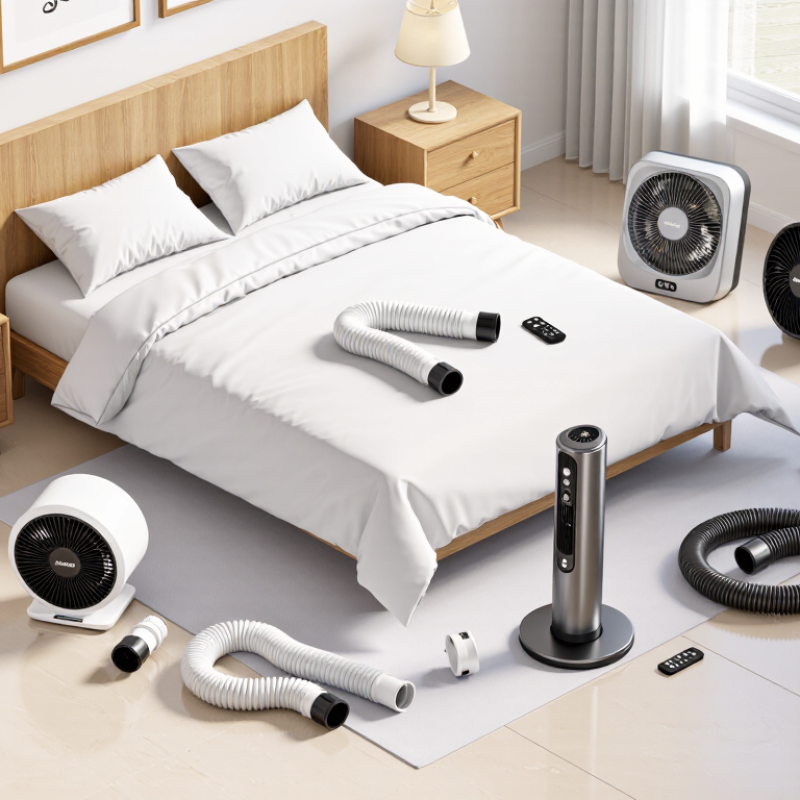
A bed fan cools the sleeper by moving room air through the space beneath a top sheet. Most designs sit near the foot of the bed and guide airflow under the covers. A fan unit pushes air through a short outlet or flexible channel. The moving air helps carry heat and moisture away from the body. It does not usually chill the mattress itself.
The principle is simple.
The sensation depends on airflow direction, fan speed, sheet thickness, and room humidity. A light cotton sheet may let air spread gently, while heavier bedding can trap it. Some users prefer a low setting because stronger airflow may feel drafty around the legs. Airflow matters more. Bed fans can ease the stuffy feeling under covers, but they cannot control the whole room’s temperature. That distinction is easy to miss when comparing cooling options.
Keep the outlet clear, secure any duct, and follow the unit’s setup instructions. A small placement change can alter where the breeze lands. Results are not perfectly even; bedding shifts during sleep, and airflow can become uneven. That’s worth considering.
China’s bed-fan industry is better understood as a layered supply chain than a list of famous factories. A small-appliance manufacturer may handle design and final assembly. Specialist suppliers provide motors, molded housings, control boards, cables, and packaging. Many factories work as OEM or ODM partners. Some own tooling and testing equipment; others coordinate subcontractors. That difference can affect lead times, product revisions, and traceability. Bed fans also share components with broader ventilation and personal-cooling products, so factory capacity is not always dedicated. This matters.
China Household Electrical Appliances Association’s 2023 industry reporting provides useful context: the wider home-appliance sector recorded about RMB 1.84 trillion in operating revenue and RMB 121.7 billion in profit. These are sector-wide figures, not bed-fan sales. They point to the larger manufacturing network behind niche devices: component suppliers, contract assembly, quality testing, and export logistics. Factories located near motor, electronics, or plastics suppliers may reduce transport and engineering delays. Yet a product catalog may not show who makes the motor or performs the final checks. That can be easy to miss.
Tips: Ask whether the quoted factory makes the complete unit or only assembles it. Request motor specifications, airflow test conditions, sample inspection records, and a list of outsourced parts. Compare a production sample with the approved sample. Small differences in blade clearance or clamp strength can matter at the bedside. Verify any claimed certification against the exact model; paperwork alone is not a factory audit.
| Industry Segment | Typical Role | Common Capabilities | Products or Components | What Buyers Should Verify |
|---|---|---|---|---|
| Specialist bed-fan manufacturers | Design and assemble fans intended to direct air beneath bed covers for personal cooling. | Product design, airflow and noise testing, assembly, packaging, and coordination of component suppliers. | Under-bed air-delivery units, flexible air hoses, outlet nozzles, and user controls. | Airflow adjustment, operating noise, hose reach, stability, safety features, and availability of replacement parts. |
| OEM and ODM appliance factories | Manufacture products to a buyer’s specification or provide a configurable product platform. | Contract assembly, private-label options, packaging adaptation, and production planning. | Finished bed fans or adapted small-appliance platforms. | Which design elements are standard, which are customizable, who owns tooling and designs, and how product changes are controlled. |
| Small-appliance and fan suppliers | Supply established manufacturing expertise in compact fans, motors, controls, and plastic housings. | Motor and fan integration, electrical assembly, injection-molded parts, and routine production testing. | Motors, impellers, housings, switches, control boards, and power components. | Component specifications, supplier traceability, electrical test procedures, and consistency between samples and production units. |
| Component and materials suppliers | Provide parts used by product assemblers rather than selling a complete bed-fan system. | Production of molded plastics, flexible ducting, wiring, power supplies, and electronic controls. | Plastic enclosures, hoses, cables, connectors, and control components. | Material specifications, dimensional tolerances, product-change notifications, and documentation for regulated markets. |
| Product testing and compliance providers | Support manufacturers and importers with testing, inspection, and market-specific compliance work. | Electrical safety checks, performance testing, factory inspections, and review of technical documentation. | Test reports, inspection records, and compliance documentation for the relevant destination market. | Whether reports cover the exact model and configuration being purchased, and whether required approvals apply in the target country. |
| Export and sourcing intermediaries | Connect overseas buyers with factories and coordinate communication, sampling, or shipment preparation. | Supplier introductions, quotation coordination, order follow-up, and export logistics support. | Factory-sourced finished products and related export services. | Whether the intermediary is the manufacturer or an agent, who handles quality issues, and which party is responsible for product documentation. |
| Typical production workflow | Combines design, sourcing, assembly, inspection, and export preparation across a supply network. | Specification review, sample approval, component procurement, assembly, functional checks, packing, and shipment coordination. | Buyer-approved finished units and packaging prepared for the agreed order. | Approved specifications, inspection criteria, sample retention, packaging requirements, and written procedures for handling defects. |
| Common sourcing considerations | Help buyers assess suppliers without relying on unverified rankings. | Capability checks based on factory evidence, product samples, references, and documented quality processes. | Product-specific quotations, samples, technical files, and inspection plans. | Confirm the supplier’s role, compare equivalent specifications, request verifiable test documents, and agree on acceptance criteria before production. |
This table describes common roles in the supply chain; it is not a verified ranking of individual manufacturers. Capabilities and compliance requirements vary by factory, product model, and destination market.
Who Are the Top Bed Fan Manufacturers in China?
Criteria for Identifying Leading Bed Fan Manufacturers
A leading bed fan manufacturer should provide measurable evidence, not just polished product photos. Ask for airflow and noise results, including the test method, measurement distance, and operating speed. ISO 5801:2017 describes standardized fan performance testing; request comparable laboratory data and check whether the method suits the product. Small details matter. A quiet reading at one speed may hide a sharp motor whine at another. Examine power consumption, outlet temperature, cord strain relief, and stability on different mattress edges. The U.S. Energy Information Administration’s 2020 Residential Energy Consumption Survey shows that space heating and air conditioning account for about half of household site energy use. That figure is not a bed-fan performance benchmark, but it makes low-power operation worth verifying.
Factory evaluation should cover repeatability as well as a single impressive sample. Request batch inspection records, component traceability, and documented corrective actions for defects. Then compare several units from different production runs. Not just airflow. Check whether fabric covers can be removed for cleaning, whether controls remain responsive after repeated use, and whether the device stays secure when bedding shifts. A supplier’s quality certificate can help, but it cannot replace product-specific test reports. I would also ask how the manufacturer handles failures found after shipment. This is easy to overlook. Published specifications often omit awkward details, such as noise at maximum output or performance with a thick mattress. That gap deserves a follow-up question.
Criteria for Identifying Leading Bed Fan Manufacturers
Suggested 100-point evaluation framework, not measured market data or a ranking of specific companies. Verify each criterion using product test results, certifications, factory audits, and warranty documentation.
Chinese bed-fan makers generally fit three profiles: OEM/ODM appliance assemblers, motor specialists, and factories pairing textile ducts with compact fan units. Their products often place a low-profile blower beside the bed and route air through a flexible fabric tube. Look for adjustable airflow, a timer, clear cleaning instructions, and controls that are easy to reach in the dark.
The International Energy Agency’s 2018 Future of Cooling report projected that global air-conditioner stock could rise from 1.6 billion units to 5.6 billion by 2050, while cooling-related electricity demand could more than triple. That wider trend helps explain interest in personal airflow devices, but it does not prove that every bed fan saves energy. Compare measured power use, airflow, and noise at the user’s actual sleeping distance. That matters at night.
Product sheets can look reassuring. Still, this comparison is imperfect. A supplier may list motor speed but omit how evenly air travels along the duct. Ask for airflow test conditions, sound measurements, material details, and spare-part availability. One point is easy to overlook: a quiet fan can still feel drafty if its outlet sits too close to the sleeper.
When comparing Chinese bed-fan manufacturers, ask for airflow, noise, and power readings at several speed settings. A single maximum-airflow figure tells little about bedside comfort. Request test conditions too: distance, room setup, and sound-meter position can change results. ISO’s 2022 Survey recorded about 1.27 million ISO 9001 certificates worldwide. This shows how common documented quality systems are, but certification alone does not prove a fan is quiet, durable, or well assembled.
Check whether the supplier can share batch inspection records, motor endurance-test results, and a sample with the same components as the production order. Inspect the grille, cable joints, and controls; these details are easy to overlook. Ask how quickly the service team responds, which spare parts it stocks, and how it handles defects. Get the warranty and response times in writing. A polished sample is not enough. I would still verify a pilot batch, because small production changes can affect noise or airflow.
Tips: Ask for raw test data, not only a pass statement. Compare readings using the same conditions, then test a sample beside a bed at low speed. Note any rattling after several hours. ISO 9001 is a useful process signal, not a performance guarantee (ISO, The ISO Survey 2022).
