For OEM buyers, choosing kitchen faucet accessories is not just a matter of adding features. The right parts affect installation, daily use, maintenance, and the overall value of a faucet line. Kitchen Faucet Accessories Oem sourcing may include pull-down sprayers, flexible hoses, aerators, mounting kits, soap dispensers, and replacement cartridges. Small parts matter.
A sprayer should feel steady in the hand, switch modes cleanly, and connect securely to its hose. An aerator can shape the water stream, while a mounting kit can make installation easier across different countertop thicknesses. Compatibility deserves close attention. A low-cost component may create extra assembly work if dimensions, finishes, or connection types do not match the faucet design. Details can be easy to miss.
This guide looks at the accessories OEM buyers commonly evaluate and the practical questions behind each choice. Buyers can compare material specifications, finish consistency, replacement-part availability, and sample performance before confirming an order. Product documentation helps, but it does not replace checking fit and operation on a physical sample. Even a polished sample may not reflect every production batch, so quality checks should continue after approval. There is no single ideal accessory set: project requirements, price targets, and customer expectations differ. A careful selection process helps buyers build faucet packages that are functional, easier to assemble, and better suited to their intended market.
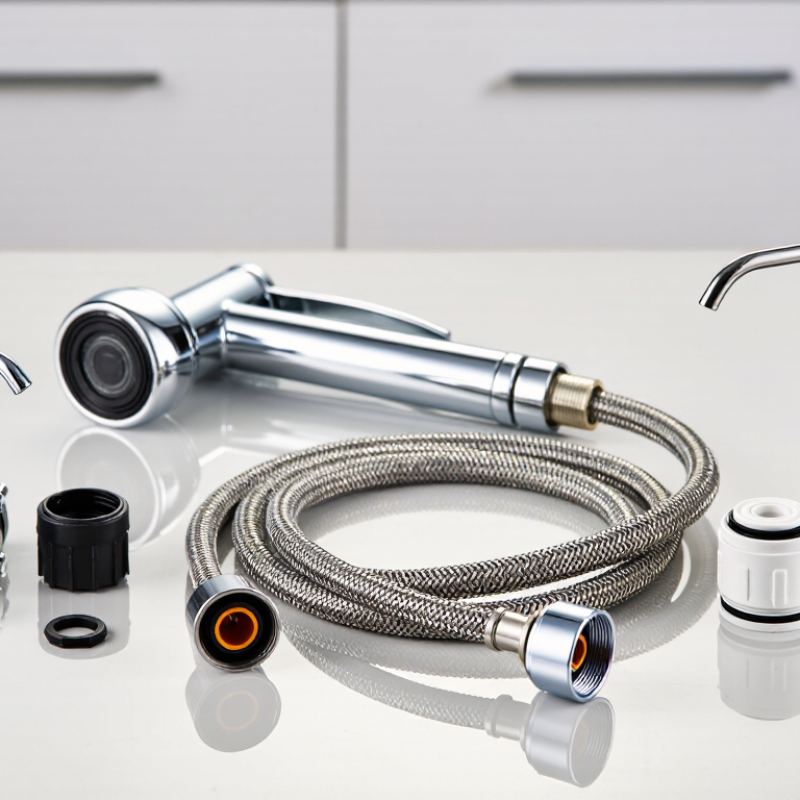
Kitchen faucet accessories do more than complete a fixture. They shape how it feels to use, install, and maintain. Pull-down spray heads offer a focused stream for rinsing produce, while flexible hoses need reliable retraction and docking. Aerators help control splash and flow. Side sprayers, soap dispensers, and filtration connections can support different kitchen layouts, but each adds installation and compatibility requirements.
For OEM buyers, these parts form a practical product-line strategy. Shared cartridges, mounting kits, and hose connections can simplify assembly and spare-parts planning across models. The 2024 Houzz & Home Study reported a median U.S. kitchen-remodel spend of $24,000. That investment context makes perceived durability and everyday convenience important purchasing factors, even for relatively small components. Small parts matter. Yet accessory counts can mislead: a broad assortment is not useful if fittings vary unexpectedly or instructions leave installers guessing.
Evaluate accessories as working systems, not isolated items. Test spray switching with wet hands, check hose clearance beneath a deep sink, and inspect docking after repeated use. Record fit, leakage, finish wear, and replacement-part needs during product validation. One detail is easy to overlook: a polished sample may perform differently after installation. OEM specifications should define connection dimensions, materials, and test conditions clearly, while leaving room for regional sink and cabinet variations.
| Accessory | Primary Role | Common Materials or Features | OEM Product-Line Considerations | Useful Quality Checks |
|---|---|---|---|---|
| Pull-down or pull-out spray head | Provides selectable stream and spray functions for rinsing dishes and cleaning the sink. | Typically uses a molded polymer body, spray-face elastomer nozzles, and an internal flow-control mechanism. | Offer compatible finish options and clearly specify spray modes, head dimensions, and hose connection requirements. | Check mode switching, spray pattern, nozzle alignment, finish consistency, and leak-free connections. |
| Spray hose | Connects a pull-down or pull-out spray head to the faucet waterway while allowing movement. | Common constructions include a flexible polymer inner tube with a braided or smooth outer covering. | Match hose length, connector type, bend behavior, and routing space to the faucet design and installation configuration. | Inspect for kinks, abrasion, secure fittings, water leakage, and reliable retraction during repeated use. |
| Hose counterweight or retraction aid | Helps guide the spray hose back into the faucet spout after use. | May be a coated metal weight or another purpose-designed retraction component. | Position it to avoid interference with cabinet contents, plumbing, and other under-sink components. | Verify smooth hose travel, reliable return, secure attachment, and clearance throughout the hose’s movement. |
| Escutcheon or deck plate | Covers unused mounting holes and provides a finished appearance for compatible sink or countertop layouts. | Often made from metal or plated material, with a gasket or sealing layer underneath. | Define the faucet-hole coverage, plate dimensions, finish match, and whether the plate is included or optional. | Check flatness, edge finish, finish consistency, gasket fit, and compatibility with the intended mounting surface. |
| Mounting hardware | Secures the faucet to a sink or countertop. | May include a mounting nut or bracket, threaded components, washers, and a positioning aid. | Specify compatible countertop thickness and installation-tool access; keep small parts organized in the package. | Confirm thread fit, corrosion-resistant construction where appropriate, secure clamping, and completeness of the kit. |
| Hot- and cold-water supply lines | Connect the faucet inlets to the household water supply. | Typically flexible hoses with end fittings suited to the faucet inlet and local plumbing connections. | Confirm fitting types, hose length, installation instructions, and suitability for the target market’s plumbing requirements. | Check connection compatibility, hose condition, leak performance, and clear identification of hot and cold lines. |
| Aerator or flow-control insert | Shapes the water stream and can help control faucet flow, depending on the design. | Commonly includes a small insert with mesh or molded flow-shaping elements. | Specify the intended flow behavior and service method; ensure the insert matches the faucet outlet and applicable requirements. | Inspect stream quality, seating, ease of removal for cleaning, and resistance to clogging under intended use conditions. |
| Soap or lotion dispenser | Adds a countertop-mounted dispensing option for compatible sinks and work surfaces. | Usually includes a pump head, refillable bottle or reservoir, and a mounting shank. | Coordinate finish, mounting-hole needs, refill access, and the dispenser’s position relative to the faucet. | Check pump action, leakage, secure mounting, refill access, and compatibility with the intended liquid. |
| Side spray and hose | Provides a separate handheld spray function in faucet configurations designed for a side spray. | Typically includes a spray handle, flexible hose, and a compatible connection or diverter arrangement. | Confirm that the faucet body supports the side-spray connection and that the sink layout provides a suitable mounting hole. | Test spray operation, hose flexibility, connection sealing, and proper interaction with the faucet diverter. |
| Installation and care components | Support correct installation, basic maintenance, and protection of the product during shipment. | May include an instruction sheet, care guidance, protective caps, and small installation accessories. | Use clear, market-appropriate instructions and align package contents with the product configuration and sales channel. | Review instruction accuracy, parts-list completeness, legibility, and protection against finish damage in transit. |