China Top 10 Wire Cable Manufacturers? Choosing a reliable wire cable manufacturer in China requires more than scanning a ranking page. Factories may look similar online, yet their capabilities can differ sharply. This guide examines ten established manufacturers through practical purchasing criteria. It considers product range, material control, testing systems, export experience, and technical support. Not just marketing claims. A cable sample, factory certificate, and inspection record often reveal more than polished photographs.
The review focuses on manufacturers serving power, construction, telecommunications, industrial automation, and renewable energy projects. It considers copper and aluminum conductors, insulation compounds, voltage ratings, shielding, fire performance, and custom lengths. These details matter when cables run through crowded cabinets, underground ducts, or outdoor trays exposed to heat and moisture. Evidence remains important. Where available, the discussion references recognized quality systems, laboratory testing, production capacity, and customer service practices. However, certifications can expire, and factory information can change. That limitation deserves attention.
Readers should treat this list as a focused starting point, not an unquestionable verdict. The best wire cable supplier depends on application, compliance requirements, delivery schedule, and total lifecycle cost. A low quotation may hide thinner insulation, limited testing, or slower technical responses. A higher price may be justified, but not automatically. Ask for current datasheets, third-party test reports, sample approval, and clear warranty terms before placing an order. The following comparison aims to make that process clearer, while acknowledging that no ranking can replace professional verification.
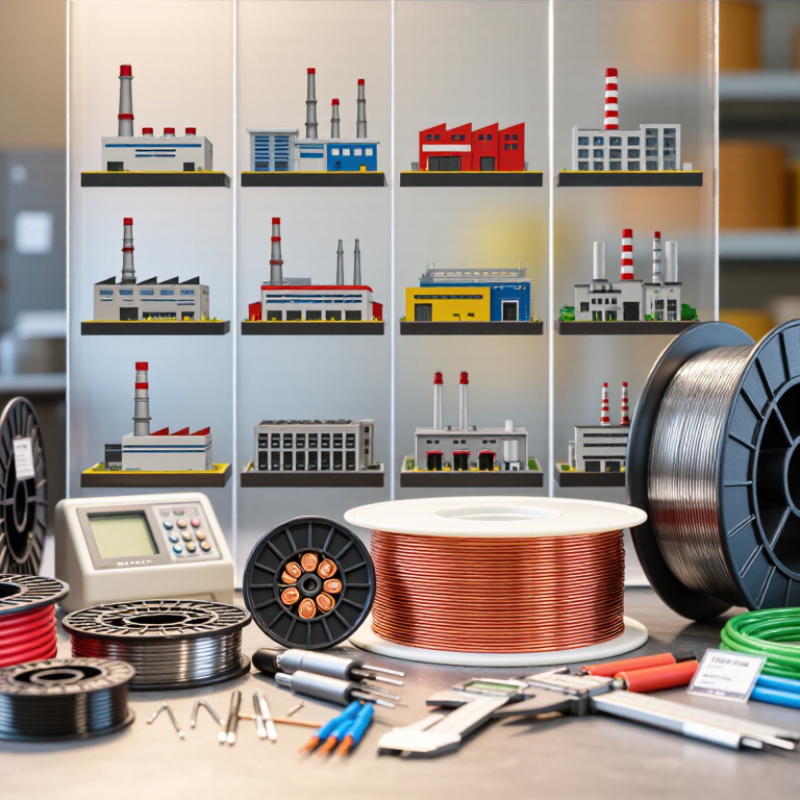
China’s wire and cable industry covers power transmission, construction, industrial automation, telecommunications, transportation, and renewable energy. Demand is strongest where urban expansion meets grid modernization. High-voltage cables carry electricity across long distances, while low-voltage wires serve buildings, lighting systems, and control panels.
Product categories differ by conductor, insulation, voltage rating, and installation environment. Copper offers strong conductivity and flexibility, while aluminum can reduce weight and material cost. PVC remains common in general construction. XLPE insulation supports higher operating temperatures and demanding power applications. Fire-resistant, halogen-free, shielded, coaxial, fiber-optic, and photovoltaic cables address more specialized requirements.
Details matter here. A cable for a solar project may face ultraviolet exposure, rooftop heat, moisture, and repeated movement. An industrial cable may need oil resistance, bending endurance, and stable signal transmission. Buyers should check conductor size, insulation thickness, temperature range, testing records, and certification scope. Factory visits and sample testing reveal practical quality better than brochures alone.
The market is broad, but not every supplier fits every project. Some manufacturers excel at standardized building wires, while others handle engineered cable systems and export documentation. Delivery consistency can matter as much as laboratory performance. A technically sound cable still creates problems if labeling, drum protection, or installation guidance is weak. That is an uncomfortable point, but it deserves attention.
Selecting China’s top 10 wire and cable manufacturers requires more than comparing annual sales. A credible review should combine audited revenue, production capacity, export performance, and delivery reliability. CRU’s 2024 Wire and Cable Market Outlook identifies grid expansion, renewable-energy connections, and infrastructure upgrades as major demand drivers. These factors help separate stable manufacturers from companies benefiting from short-term orders.
Quality data must be measurable. The selection process should examine factory audits, batch traceability, conductor resistance, insulation thickness, and documented failure rates. IEC standards provide useful technical benchmarks for cable testing and safety. ISO 9001 certification can support process control, but certification alone is not enough. Independent laboratory results and recent project records should also be checked.
Look closely.
Financial resilience matters too. A manufacturer with modern extrusion lines, copper inventory controls, and documented research spending is better prepared for volatile material prices. Export records can reveal experience with customs documentation and different compliance requirements. Industry data from the China Electricity Council can help verify market participation and power-sector demand trends.
No ranking is perfect. Public data may be incomplete, while some firms report capacity differently. I would therefore score each manufacturer across weighted categories: 25% quality, 20% delivery, 20% technical capability, 15% financial strength, 10% export experience, and 10% customer evidence. This method is less dramatic than choosing by reputation, but it is easier to audit and improve.
China’s top ten wire and cable manufacturers are best assessed through capability, not publicity. Their profiles usually reveal different strengths: power transmission, building wire, control cable, mining cable, railway systems, renewable energy, marine use, data networks, fire-resistant products, and custom engineering. Strong producers control copper or aluminum drawing, insulation extrusion, stranding, and final testing. Their facilities often include clean production areas, laser diameter checks, and high-voltage test rooms. These details matter more than a polished website.
Reliable manufacturers document conductor resistance, insulation thickness, tensile strength, flame behavior, and aging performance. For medium-voltage cable, engineers should examine partial-discharge results and the quality of XLPE processing. Export experience also matters. Clear test reports, traceable batch numbers, and stable packaging reduce project risks. Some factories offer impressive equipment but weak after-sales communication. That is worth questioning. A ranking can also change by application, budget, and delivery region.
Tips: Request samples from several of the ten profiled manufacturers. Compare copper purity, flexibility, surface finish, and printed markings. Ask for recent factory audits and third-party test records. Confirm standards, voltage ratings, minimum order quantities, and replacement procedures in writing. Check whether the quoted lead time includes testing and export packing. Do not judge cable quality by weight alone; excessive filler can create a misleading impression. My view may be incomplete, because supplier performance can shift with materials, staffing, and project pressure.
Anonymized comparison of representative Chinese wire and cable manufacturing profiles
| No. | Manufacturer Profile | Core Product Categories | Primary Application Sectors | Common Standards and Certifications | Typical Export Regions | Key Capability Indicators |
|---|---|---|---|---|---|---|
| 01 | Profile A Large-scale integrated cable producer |
Power cables Overhead conductors Control cables | Utility transmission, distribution networks, industrial facilities, infrastructure projects | IEC, GB/T, ASTM, ISO 9001, ISO 14001, CCC where applicable | Asia, Africa, the Middle East, Latin America | Broad voltage range, in-house testing laboratories, large project-order capacity, copper and aluminium conductor processing |
| 02 | Profile B Specialty industrial cable manufacturer |
Flexible cables Automation cables Robotics cables | Factory automation, machinery, robotics, control systems, material-handling equipment | IEC, GB/T, UL or CSA for selected products, ISO 9001 | Europe, North America, Southeast Asia | High-flexibility designs, drag-chain performance, oil and abrasion resistance, customized constructions |
| 03 | Profile C Building and low-voltage cable specialist |
Building wires Low-voltage power cables Fire-resistant cables | Residential buildings, commercial construction, public facilities, electrical installation | IEC, GB/T, CCC, RoHS, ISO 9001; fire-performance approvals where required | Domestic Chinese market, Southeast Asia, the Middle East | High-volume extrusion, color and insulation customization, flame-retardant and low-smoke options |
| 04 | Profile D Renewable-energy cable producer |
Solar cables Wind-power cables Battery cables | Photovoltaic plants, wind farms, energy-storage systems, electric-vehicle infrastructure | IEC, EN, TÜV requirements for applicable products, UL for selected markets, ISO 9001 | Europe, Australia, North America, Asia-Pacific | UV resistance, weather resistance, halogen-free options, temperature-resistant insulation systems |
| 05 | Profile E High-voltage and utility cable manufacturer |
Medium-voltage cables High-voltage cables Substation cables | Power grids, substations, rail electrification, industrial power distribution | IEC, GB/T, AEIC or equivalent utility specifications, ISO 9001, ISO 14001 | Asia, the Middle East, Africa and selected European markets | Semiconductive shielding, insulation-screening processes, partial-discharge testing, project engineering support |
| 06 | Profile F Telecommunication and data cable producer |
LAN cables Coaxial cables Fiber-optic cables | Data centers, broadband networks, telecom infrastructure, security systems | IEC, ISO/IEC 11801, ANSI/TIA requirements, RoHS, ISO 9001 | North America, Europe, Asia-Pacific, Africa | Impedance control, bandwidth-focused designs, fiber and copper assembly, batch traceability |
| 07 | Profile G Marine and offshore cable supplier |
Marine cables Offshore cables Shipboard control cables | Commercial vessels, offshore platforms, ports, marine engineering projects | IEC, marine classification requirements, DNV, ABS or other applicable approvals | East Asia, the Middle East, Europe, Southeast Asia | Flame retardance, low smoke and halogen-free options, oil resistance, vibration-resistant construction |
| 08 | Profile H Railway and transportation cable manufacturer |
Railway cables Signal cables Rolling-stock cables | High-speed rail, urban transit, railway signaling, transportation control systems | IEC, EN 45545-2, relevant railway specifications, ISO 9001, ISO 14001 | Asia, the Middle East, Africa, Latin America | Low-smoke and low-toxicity materials, vibration resistance, electromagnetic compatibility control, custom harnessing |
| 09 | Profile I Mining and heavy-duty cable producer |
Mining cables Rubber cables Heavy-duty trailing cables | Mining machinery, tunnels, construction equipment, heavy industrial sites | IEC, GB/T, MSHA or regional mine-safety requirements, ISO 9001 | Australia, Africa, Central Asia, South America | High mechanical strength, impact resistance, flame retardance, flexible rubber insulation and sheathing |
| 10 | Profile J Custom cable and harness manufacturer |
Special cables Cable assemblies Wiring harnesses | Automotive systems, medical equipment, industrial electronics, measuring instruments | ISO 9001, IATF 16949 for applicable automotive operations, RoHS, REACH | Europe, North America, Japan, Southeast Asia | Prototype development, small-to-medium batch production, connector assembly, electrical continuity and insulation testing |
China’s top ten wire and cable manufacturers serve different technical niches. One focuses on low-voltage building wires, using flame-retardant PVC and automated conductor stranding. Another produces medium-voltage cables with cross-linked polyethylene insulation for substations and industrial parks. A third supplies overhead conductors, including aluminum alloy and steel-reinforced designs for long transmission spans. Its testing usually checks tensile strength, elongation, and electrical resistance.
A fourth manufacturer makes control and instrumentation cables for factories, where shielding reduces signal interference. A fifth develops flexible cables for cranes, robotic arms, and moving production lines. A sixth specializes in submarine and offshore cables, adding water-blocking layers and stronger armor. A seventh serves rail transport with low-smoke, halogen-free products. A small detail matters: smoke performance can affect evacuation time.
An eighth producer supplies mining cables with heavy jackets for abrasion and impact resistance. A ninth makes photovoltaic and energy-storage cables, using insulation designed for heat, sunlight, and repeated temperature changes. The tenth focuses on communication cables, including fiber-optic, data, and hybrid power-signal assemblies. These manufacturers commonly use extrusion control, online diameter monitoring, partial-discharge testing, and aging evaluations. Certification supports reliability, but it is not the whole story. Installation quality still decides field performance. That point is easy to underestimate. Buyers should compare conductor material, insulation system, bending radius, test records, and service conditions. Some product catalogs appear broad, yet customization capacity may be limited. Factory visits and sample testing remain valuable.
Choosing a Chinese wire and cable manufacturer requires more than ranking lists. A “top ten” label says little about fit. Define the cable’s voltage, conductor material, insulation, temperature range, bend radius, and installation environment. Ask for drawings, test methods, and production tolerances. A serious manufacturer should explain these details clearly, not hide behind general claims. Request recent test reports from accredited laboratories, and verify whether they match the exact construction you plan to buy.
Visit the factory when practical, or arrange a live video audit. Check copper or aluminum storage, extrusion lines, spark testers, and finished-cable protection. Production records should connect each batch to raw materials, operators, test results, and shipment labels. Ask how nonconforming cable is isolated. The answer matters. Also review quality certificates, worker training, fire-safety controls, and environmental procedures. Certificates alone are not proof of consistent performance.
Compare sample results, not only quotations. A low price may reflect thinner insulation, vague tolerances, or limited testing. Confirm minimum order quantities, lead times, packaging, warranty terms, and technical support in writing. For a first order, use a small pilot batch with independent inspection before scaling. No supplier evaluation is perfect. A second sample may reveal variation that the first sample missed. Keep communication technical and documented. If explanations change between sales staff and engineers, pause and investigate. Reliable sourcing is slower at the beginning, but it reduces costly surprises during installation and service.