How to Choose the Right Steel Wire for Your Project?

Choosing the right steel wire begins with the job, not the catalogue title. A bridge cable, spring, welding product, and fence require different performance priorities. Tensile strength alone does not guarantee success. Diameter tolerance, ductility, fatigue resistance, surface condition, and corrosion protection can change the result significantly.

The World Steel Association’s World Steel in Figures 2024 reports 1,892.2 million tonnes of crude steel production in 2023. This scale reflects a mature, highly engineered supply chain, but it also creates confusing material choices. ISO 16120 covers non-alloy steel wire rod for conversion into wire, while ASTM specifications address defined applications and testing requirements. These references help buyers compare chemistry, mechanical properties, and manufacturing consistency. Still, standards are starting points. They do not replace checking the actual load, bending radius, temperature, or exposure conditions.

That choice matters.

Practical purchasing reviews often reveal a simple mistake: selecting the highest-strength steel wire without considering forming or installation. A hard wire may resist tension but crack during tight bending. A bright finish may look clean but deteriorate quickly in salt air. Coated wire can improve durability, yet coating thickness and adhesion need verification. The World Bank’s Commodity Markets Outlook also shows how energy and raw-material prices influence metal costs, making price-only comparisons unreliable. A dependable selection weighs performance, certification, lifecycle cost, and supplier testing records together. Some project assumptions will be incomplete. Recheck them before ordering. A careful decision leaves room for technical review, because the cheapest wire is rarely the safest choice.
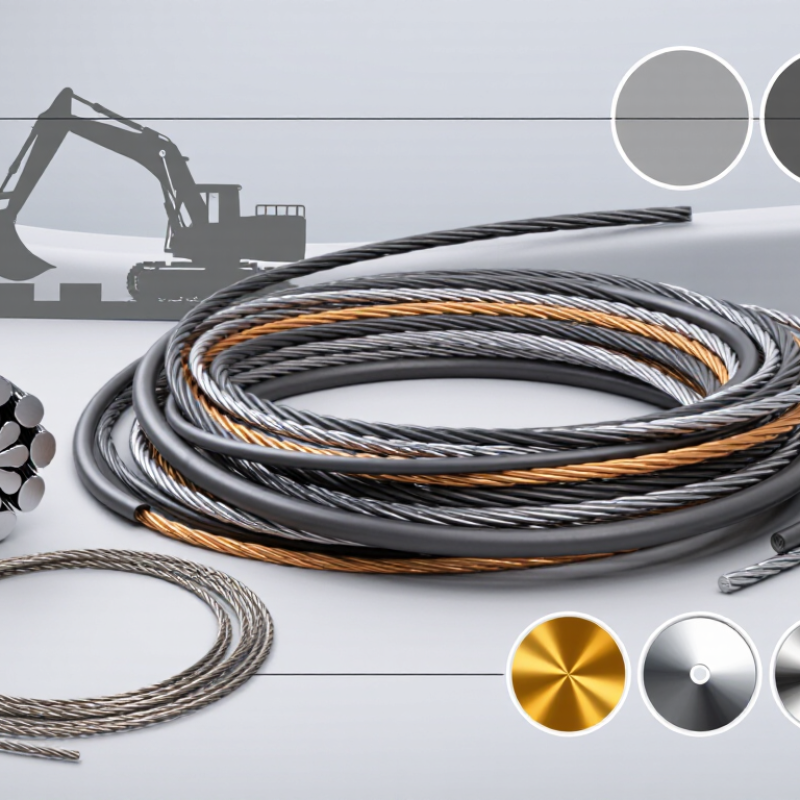
How to Choose the Right Steel Wire for Your Project?

Define Load, Safety Factor, and Required Tensile Strength: 400–2,000 MPa

Choosing steel wire begins with the real load, not the number printed on a drawing. Measure the static weight, pulling direction, impact, and loading frequency. A 500 kg load creates about 4.9 kN under normal gravity. Add equipment weight and possible movement. Then apply a safety factor. For steady, inspected lifting, engineers may select a lower factor than for shock loading. The exact value depends on design codes, service conditions, and failure consequences. Guessing here is risky. I have seen tidy calculations fail because the starting load was incomplete.

Required tensile strength links force to wire area. Use this basic check: required strength equals design load divided by cross-sectional area. Design load equals working load multiplied by the safety factor. If a wire carries 10 kN across 50 mm², its design stress is 200 MPa. A wire rated at 400 MPa may suit mild, static service. Higher-strength steel, reaching 2,000 MPa, can support greater demands. Tensile rating alone does not approve a design. Terminations, bends, abrasion, corrosion, and fatigue can reduce usable capacity.

Select wire with certified minimum tensile strength above the calculated requirement. Keep a practical margin. Check the actual diameter, lay, coating, and end fittings. Verify certificates and test methods from a competent supplier. For outdoor exposure, inspect rust and broken strands regularly. Small-radius sheaves deserve attention. They can damage wire before visible overload occurs. My first estimate would not survive every field condition. Recalculate when temperature, geometry, or loading changes. Record assumptions clearly, so another engineer can challenge them.

Match Carbon Content to Performance: Low-Carbon <0.25% vs High-Carbon 0.60–0.95%

Choosing steel wire begins with carbon content, but the number is only a starting point. Low-carbon steel, below 0.25% carbon, usually offers better ductility, bendability, and weldability. It suits tie wire, forming operations, mesh, and parts requiring repeated shaping. In practical work, low-carbon wire feels more forgiving during drawing and bending. It is less likely to crack at a tight radius.

High-carbon steel, typically 0.60–0.95% carbon, delivers greater hardness, tensile strength, and fatigue resistance after suitable processing. It fits springs, cutting wires, high-strength ropes, and wear-resistant components. The trade-off is clear. Ductility decreases. Welding becomes more sensitive. Excessive forming can create surface cracks, especially when lubrication or heat treatment is poorly controlled. ASTM A510/A510M testing requirements help verify mechanical consistency, but the standard does not replace application testing.

Industry scale also explains why traceability matters. World Steel Association data reports approximately 1.89 billion tonnes of crude steel production in 2023. The U.S. Geological Survey’s Mineral Commodity Summaries 2024 gives a similar global estimate. Such volume does not guarantee suitable wire quality. Chemistry, drawing reduction, surface condition, and heat treatment still vary between lots. A useful selection mistake is choosing carbon content alone. I would also check tensile strength, elongation, wire diameter tolerance, and corrosion exposure. Test a short coil under real bending conditions. Laboratory values can look excellent, yet the wire may fail at the first sharp bend.

Select Wire Diameter from Load Capacity, Deflection, and ASTM A510 Tolerances

Choosing steel wire by diameter alone can cause trouble. I have seen projects pass a strength check but fail because the wire deflected too much.

Start with the working load, not the breaking load. Calculate the required cross-sectional area using tensile strength, applied force, and a suitable safety factor. Include shock loads, bending, vibration, and repeated cycles. A wire that survives one pull may still fatigue during daily movement.

Deflection deserves equal attention. For a straight tension member, elongation depends on force, length, area, and elastic modulus. The relationship is simple: longer wires stretch more, while larger diameters reduce elongation quickly. Diameter also affects area by its square. A small change matters. Do not rely on nominal diameter alone.

ASTM A510/A510M provides general requirements for carbon steel wire and wire rod, including dimensional controls. Check the applicable edition and the specified tolerance table for the wire size and product condition. A diameter near the lower tolerance limit has less load capacity than its nominal value suggests. Measure production samples with a calibrated micrometer at several points, then compare results with the purchase specification and mill documentation. This step is easy to skip. That is where errors hide.

Prototype testing can expose issues that calculations miss. Record actual load, elongation, surface damage, and any permanent set. If the result looks acceptable only under perfect conditions, the design probably needs another review.

How to Choose the Right Steel Wire for Your Project? - Select Wire Diameter from Load Capacity, Deflection, and ASTM A510 Tolerances

The table below provides a preliminary comparison for round carbon steel wire. Values are engineering estimates for diameter selection and must be checked against the actual material grade, temper, surface condition, end fixing, fatigue requirement, and applicable purchase specification.

Nominal Wire Diameter
(mm)
Cross-Sectional Area
(mm²)
Approx. Mass
(kg/m)
Screening Load at
600 MPa (N)
Load for 2 mm Deflection
(N)
Governing Screening Load
(N)
Diameter Control Consideration
1.00 0.785 0.0062 236 0.01 0.01 Very sensitive to diameter variation; verify the ordered ASTM A510/A510M tolerance and straightness.
2.00 3.142 0.0247 1,885 0.12 0.12 Deflection governs strongly for a 500 mm span; specify diameter and temper separately.
3.00 7.069 0.0555 6,362 0.61 0.61 Use a tighter project tolerance when deflection or fit-up is critical.
4.00 12.566 0.0987 15,080 1.93 1.93 A practical range for moderate loads; confirm the specified dimensional tolerance before production.
5.00 19.635 0.1541 29,452 4.71 4.71 Higher stiffness and load capability; check bending, forming, and handling requirements.

ASTM A510/A510M Dimensional-Control Checklist

Control Item What to Specify or Verify Why It Matters
Nominal diameter State the required diameter in millimetres and the applicable ASTM A510/A510M product classification or purchase specification. Wire stiffness varies approximately with the fourth power of diameter, while tensile area varies with the square of diameter.
Diameter tolerance Do not assume one universal ASTM A510/A510M tolerance. Confirm the tolerance table, wire class, size range, and any tighter project requirement on the order. A small diameter reduction can significantly reduce stiffness and bending-load capacity.
Material grade and carbon content Specify the required steel chemistry, grade, and applicable mechanical-property requirements. Strength, ductility, weldability, and forming performance depend on chemistry and processing.
Temper or tensile-strength range Specify annealed, drawn, or other required condition together with the required tensile-strength range when applicable. The 600 MPa value used in the screening table is an assumption, not a universal ASTM requirement.
Surface and coating Identify bright, oiled, cleaned, galvanized, or other required surface condition. Surface condition affects corrosion resistance, friction, fatigue performance, and final dimensions.
Inspection records Request diameter measurements, tensile-test results, heat or lot identification, and certificate documentation where required. Documented verification helps confirm that the delivered wire meets the ordered specification.
Calculation basis: solid round wire, steel density 7,850 kg/m³, elastic modulus 200 GPa, simply supported span of 500 mm, centre-point load, maximum deflection of 2 mm, and assumed screening stress of 600 MPa. Cross-sectional area = πd²/4; bending deflection = PL³/(48EI); screening stress load = 600πd³/8. The governing load is the lower of the stress-based and deflection-based values. These figures are for preliminary comparison only and are not a substitute for a project-specific structural or fatigue design.

Specify Corrosion Protection Using ASTM A641 Zinc-Coating Classes

How to Choose the Right Steel Wire for Your Project?

Specify Corrosion Protection Using ASTM A641 Zinc-Coating Classes

Choosing steel wire starts with the environment, not the spool label. Indoor storage, coastal air, wet soil, and road salt create very different corrosion risks. ASTM A641 provides zinc-coating classes for carbon steel wire, with higher classes generally requiring heavier zinc protection. The wire diameter also affects the specified coating mass. Therefore, do not select a class by number alone. Review the applicable table, wire grade, diameter, and intended use together. A heavier coating can improve service life, but it may affect forming, welding, or surface appearance.

In practical projects, I check whether the wire will be bent after coating. I also ask for coating adherence and coating-mass test results. A certificate should identify the ASTM A641 edition, coating class, wire diameter, and test method. These details help prevent a common mistake: accepting “galvanized” as a complete specification. It is not. Zinc quality, handling damage, storage humidity, and cut-end exposure still matter.

Tips: Match the coating class to actual exposure. Protect cut ends when practical. Avoid dragging coils across rough concrete. Inspect for bare spots, peeling, or heavy surface damage before installation. If the project has unusual chemicals or constant immersion, ASTM A641 alone may not predict service life. Ask a qualified materials engineer to review the conditions. I have seen reasonable selections fail because the environment was underestimated. That deserves a second look.

How to Choose the Right Steel Wire for Your Project?

ASTM A641/A641M defines three zinc-coating classes for carbon steel wire. The class level is an ordinal requirement: for the same nominal wire diameter, a higher class requires a higher minimum zinc-coating amount.

The chart shows the ASTM A641 coating-class level, not a coating-mass value. Confirm the exact minimum zinc coating mass in the current ASTM A641/A641M table for the selected wire diameter.

Verify Grade, Testing, and Dimensions Against ISO 16120 or EN 10218-2

Choosing steel wire starts with the specification, not the catalogue photograph. World Steel Association data recorded 1.888 billion tonnes of crude steel production in 2023. That scale creates many grades, surface conditions, and drawing qualities. Small differences matter.

Check the wire rod grade against the relevant part of ISO 16120. Confirm chemical limits, tensile requirements, heat number, and delivery condition. Request the mill test certificate before approving production. Compare its results with independent test reports when the application carries high loads. A certificate can look complete. It may still omit the exact test method or sampling location.

For finished wire, verify diameter, ovality, and permissible tolerances against EN 10218-2. Use calibrated micrometers at several points along the coil. Record readings near the beginning, middle, and end. Do not measure only one bright section. Surface scale or a slightly flattened edge can distort the result. The OECD Steel Market Developments reports continued pressure from global steel overcapacity, so purchasing documents deserve closer scrutiny. Low prices may hide inconsistent dimensions, not better efficiency.

Ask whether the stated grade matches your forming, welding, or fatigue requirements. ISO 16120 helps define suitable wire rod quality, while EN 10218-2 addresses finished wire dimensions and tolerances. They are not interchangeable. I would also check traceability from the coil tag to the test certificate. That step is easy to skip, and it is often where confidence becomes guesswork.