Who Are the Top Stainless Chain Suppliers in China?
Choosing the right stainless chain supplier in China requires more than comparing prices on a trading platform. Buyers must examine manufacturing experience, material control, production capacity, and export reliability. A polished website can look convincing, yet it may reveal little about factory performance. This guide explores who the top stainless chain suppliers are and how their strengths differ.
The evaluation considers stainless steel grades, welding quality, dimensional accuracy, surface finishing, and load performance. It also reviews whether suppliers provide traceable material certificates, inspection reports, samples, and clear technical drawings. A reliable manufacturer should explain differences between 304 and 316 stainless steel without making vague promises. Factory audits, production photographs, and customer references can add useful evidence. Small details matter. Ask about chain pitch, link diameter, packaging, and corrosion testing before placing an order.
Price still matters, but it should not dominate the decision. A cheaper chain may bring uneven links, rough welds, or premature corrosion. That risk becomes expensive in conveyors, marine equipment, food-processing lines, and outdoor installations. No supplier is perfect. Even experienced manufacturers can miss a tolerance or delay a shipment. That assumption needs testing. Buyers should compare several qualified companies, request samples, and confirm quality procedures in writing. The following overview presents leading Chinese suppliers through a practical, evidence-based lens, helping importers select partners with stronger technical capability and more dependable long-term service.
China’s Stainless Chain Market: Grades, Standards, and Supplier Landscape
China’s Stainless Chain Market: Grades, Standards, and Supplier Landscape
China remains a major production base for stainless chain and related metal components. The International Stainless Steel Forum reported 58.4 million tonnes of global stainless crude steel production in 2023. China contributed roughly 62% of that volume, supporting a broad domestic supply network. However, steel capacity does not automatically prove chain quality. Buyers should examine traceability, heat treatment records, and load-testing procedures.
62%
China’s contribution to global stainless crude steel production in 2023.
Grade selection usually starts with 304 stainless steel for general moisture exposure and food-related equipment. 316 and 316L offer stronger resistance to chlorides and coastal environments. In practice, surface finish can matter as much as the grade. Poor polishing may leave crevices around pins and rollers. That detail is easy to miss.
ISO 606
ISO 606 provides dimensions and performance requirements for short-pitch transmission and conveyor chains.
ASTM A967
ASTM A967 is also commonly referenced for chemical passivation of stainless components.
Chinese suppliers may additionally provide products aligned with GB/T 1243 requirements.
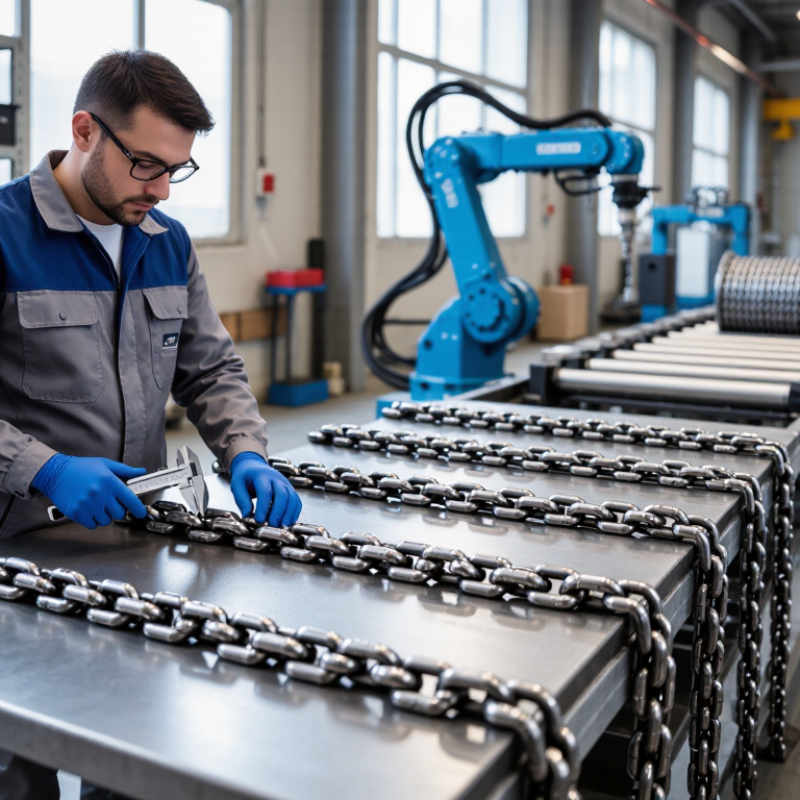
The strongest suppliers are usually manufacturers with in-house stamping, heat treatment, assembly, and inspection. Export traders can be useful, but their production visibility varies. A serious supplier should provide material certificates, dimensional reports, tensile-test results, and sample approval records.
Ask whether testing covers the complete assembled chain, not only individual parts. Some catalogs still present theoretical breaking loads without operating limits. That gap deserves careful review.
Supplier comparisons should include tolerance control, minimum order quantities, replacement support, and documented experience with the target industry.
Key Ranking Metrics: Tensile Strength, Working Load, MOQ, and Lead Time
Who Are the Top Stainless Chain Suppliers in China?
The strongest suppliers are not always the cheapest. I rank them by tested tensile strength, working load limit, MOQ, and lead time. Tensile strength shows the force a chain withstands before breaking. It does not define safe daily use. Working load must reflect link size, alloy, finish, and application. Ask for batch test reports, not attractive catalogue figures. A clear report should identify the alloy grade, test method, production lot, and inspection date.
MOQ affects cash flow, especially for custom lengths or polished surfaces. A supplier offering 100 meters may suit a trial order better than one requiring 1,000 meters. Still, unusually low MOQs can hide higher unit costs or inconsistent production. Request one sample coil and inspect welds, link spacing, surface pits, and pin alignment. Small defects matter.
Lead time needs evidence. Confirm sample approval, production days, inspection time, and shipping preparation separately. In my supplier reviews, promised delivery often excludes final inspection. That creates avoidable delays. Reliability also depends on traceability, responsive engineers, and corrective-action records. I prefer suppliers that explain a failed test openly and show how they fixed it. No ranking stays perfect. Stainless chain performance can change after salt exposure, repeated loading, or poor storage. Recheck the figures against your real operating conditions, not just the quotation.
Who Are the Top Stainless Chain Suppliers in China?
This anonymized market benchmark compares supplier groups commonly serving international stainless-chain buyers. Tensile strength and working load are shown in kN; MOQ is measured in meters, and lead time is shown in calendar days. Higher tensile strength and working load are favorable, while lower MOQ and shorter lead time are generally preferable.
Values are indicative procurement benchmarks for standard stainless-steel chain orders and may vary by chain diameter, stainless grade, finish, testing requirements, packaging, and order customization. Final specifications should be confirmed through mill certificates and load-test documentation.
Top Suppliers of 304 (18-8) and 316 (2-3% Mo) Stainless Chains
Who Are the Top Stainless Chain Suppliers in China?
China’s strongest stainless chain suppliers usually serve food processing, packaging, marine, and outdoor equipment industries. Their main materials are 304 stainless steel, also called 18-8, and 316 stainless steel, containing about 2–3% molybdenum. Grade 304 suits clean, dry, and mildly corrosive environments. Grade 316 performs better around saltwater, chlorides, and frequent washing.
Experienced buyers should inspect more than surface brightness. Ask suppliers for material certificates, tensile-test records, dimensional reports, and batch traceability. Check pitch, roller diameter, pin fit, weld quality, and allowable working load. A polished surface can hide inconsistent heat treatment. That assumption can fail. Reliable factories should explain their passivation process and provide samples before large orders. In practice, sample testing often reveals tighter tolerances or weaker joints than a catalog suggests.
Tips: Compare suppliers using the same chain specification. Confirm 304 or 316 material before discussing price. Request corrosion testing when chains face salt spray or cleaning chemicals. Visit the production line if possible, or use an independent inspection service. Also review packaging, production capacity, replacement-part availability, and communication speed. The cheapest quotation may not reflect total operating cost. A slightly higher initial price can reduce chain stretching, downtime, and premature replacement.
Supplier Verification Through ASTM A580, ISO 3506, and EN 10204 3.1
China’s stainless chain market is large, but scale alone cannot verify a supplier. The International Stainless Steel Forum reported approximately 58.4 million tonnes of global stainless crude steel production in 2023. This volume increases sourcing options, yet it also makes traceability more important. A reliable supplier should identify the steel grade, heat number, surface condition, and production route for every batch.
ASTM A580 helps buyers assess stainless steel wire, including dimensions, mechanical properties, and testing requirements. For chain assemblies using fasteners, ISO 3506 defines mechanical property classes for corrosion-resistant stainless steel fasteners. These standards are useful, but they do not replace inspection. Ask for tensile results, dimensional records, and corrosion-test details linked to the same heat number. Small gaps matter.
EN 10204 3.1 certification adds independent value because the document includes specific test results and confirms compliance with the order. Check the certificate against the material marking, purchase specification, and laboratory identity. The European Committee for Standardization identifies 3.1 inspection documents as manufacturer-issued records validated by an authorized inspection representative. That sounds strong. It is not flawless. Certificates can be incomplete, outdated, or poorly matched to delivered goods. A practical audit should include random sampling, calibrated gauge checks, and verification of the certifying laboratory. Supplier confidence grows from matching documents to metal, not from polished paperwork.
Comparing Quality, Customization, Pricing, and Export Capability
Who Are the Top Stainless Chain Suppliers in China?
China remains a major stainless steel manufacturing base. World Stainless reported 36.2 million tonnes of Chinese crude stainless steel production in 2023. That represented roughly 62% of global output. This scale can support stable material access and competitive pricing. However, large production does not guarantee better chain quality. Buyers should review tensile-test records, weld consistency, surface finish, and corrosion-test results. Cheap is not enough.
Customization separates capable suppliers from simple distributors. Experienced factories can adjust pitch, wire diameter, link shape, surface treatment, and packaging. They should also provide drawings, samples, and traceable material certificates before mass production. The ISO 9001 certificate helps, but it cannot replace process evidence. UN Comtrade data for HS 7315 shows China as a significant exporter of iron and steel chain products. Export experience therefore matters, especially for documentation, pallet protection, and container loading. The World Bank’s 2023 Logistics Performance Index ranked China 19th globally, supporting its strong logistics capability. Still, delivery estimates can be too optimistic. I would test one shipment first.
Tips: Compare three quotations using identical specifications. Ask for a sample chain under working load. Check whether the quoted price includes testing, packaging, and export documents. Request recent inspection photos, not only polished catalog images. A supplier avoiding clear tolerances deserves caution.